This is a space to pause, notice and think together. It is not a test and there is no score. You may find yourself certain in one moment and less certain in the next. That is part of reflective practice.
◎
Your reflections are anonymous. No name is collected. Your draft stays on this device until you choose to submit it. Submitted reflections are brought together for the facilitator without identifying who wrote what.
Take what is useful. Pause whenever you need to.
01 · Arriving
Where are we starting?
This is a snapshot, not a judgement. Choose the number that feels closest today.
◌ Anonymous reflection · your draft saves privately until you choose to send it
◎
First activity
How are we arriving today?
Choose one word. When you add it, it will appear anonymously in the group’s live word cloud.
1 Not yet confident3 It depends5 Mostly confident
1I can notice what is happening inside me when an incident becomes pressured.
2I recognise my early warning signs before I move outside my own regulation.
3I know what helps me recover enough to stay relational under pressure.
4I can remain curious when behaviour feels personal, provocative or rejecting.
5I can hold uncertainty without rushing to decide exactly what happened.
6I feel able to act within my role when a situation does not need escalation.
7I can recognise when another view or management support would help.
8I can recognise when something may need a safeguarding or emergency response.
9I can hold connection and accountability together after harm or damage.
10I feel able to make a first move towards repair, even when I have also been affected.
✓ Your draft saves automatically on this device. Only the responses you choose to send are added to the anonymous group view.
02 · Pause before response
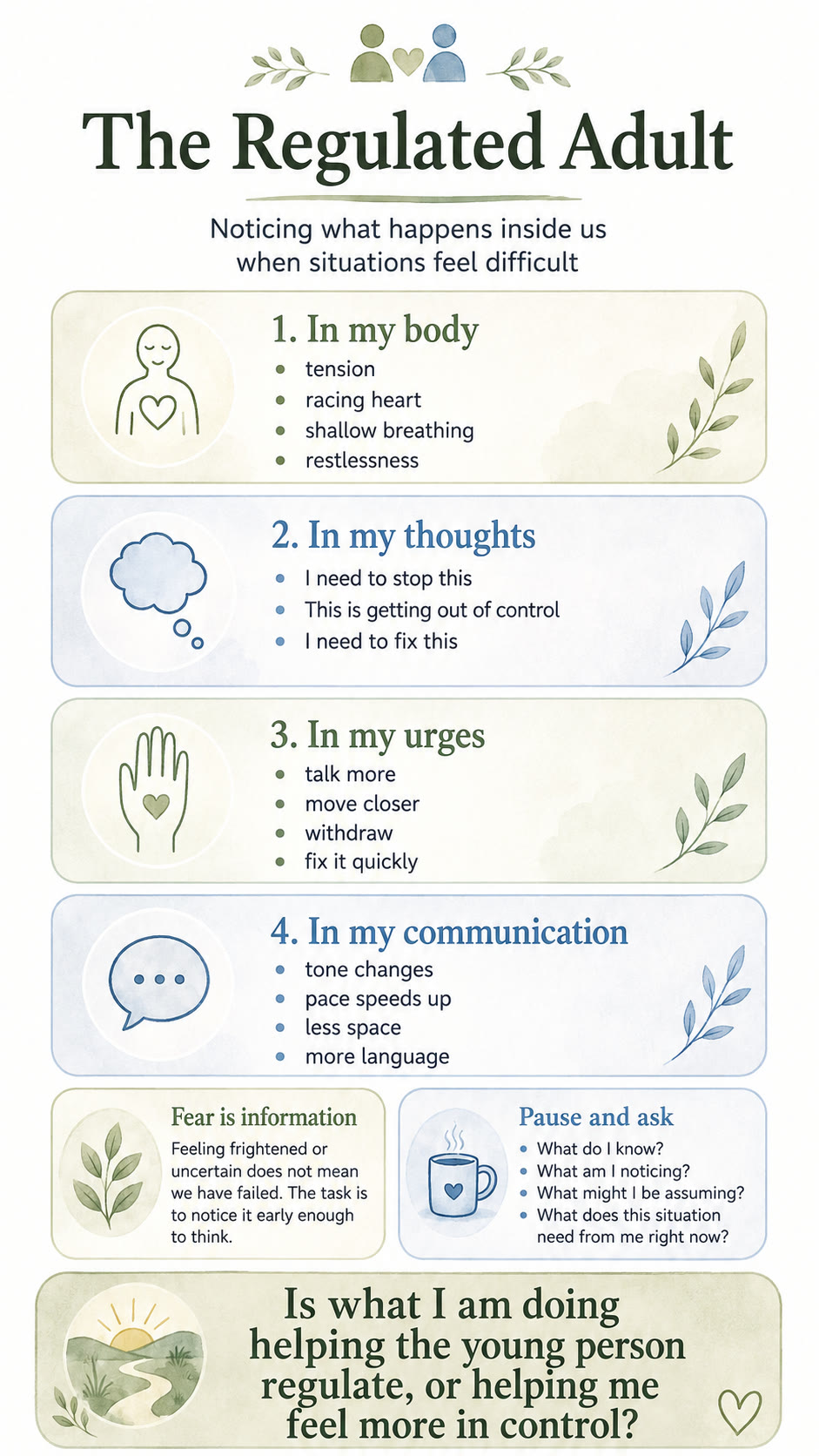
The regulated adult
Before we think about what a young person needs, we can gently notice what pressure does inside us.
Notice what happens inside us when situations begin to feel difficult.
Pause
“Is what I am doing helping the young person regulate, or helping me feel more in control?”
03 · Scenario one
The allegation
The information comes in stages. Try to stay with what is known at each point before revealing more.
12
Video 1 · First response
Pause for group discussionStay with what is known so far before continuing.
Video 2 · Another response
Not certain3 / 5Very certain
Wonder
“What happens to us when we desperately want certainty but the situation cannot give it to us yet?”
04 · Decide, seek, escalate
Professional judgement
Where would you place each situation first? Context can change the response, so there may not be one fixed answer.
ActSeek another viewManagement / on-callSafeguarding / emergency
8
You have held eight different situations in mind.
The placement may shift when more becomes known. Professional judgement includes knowing what you can hold, what benefits from another mind and what must be escalated.
05 · Scenario two
Maya & Steve
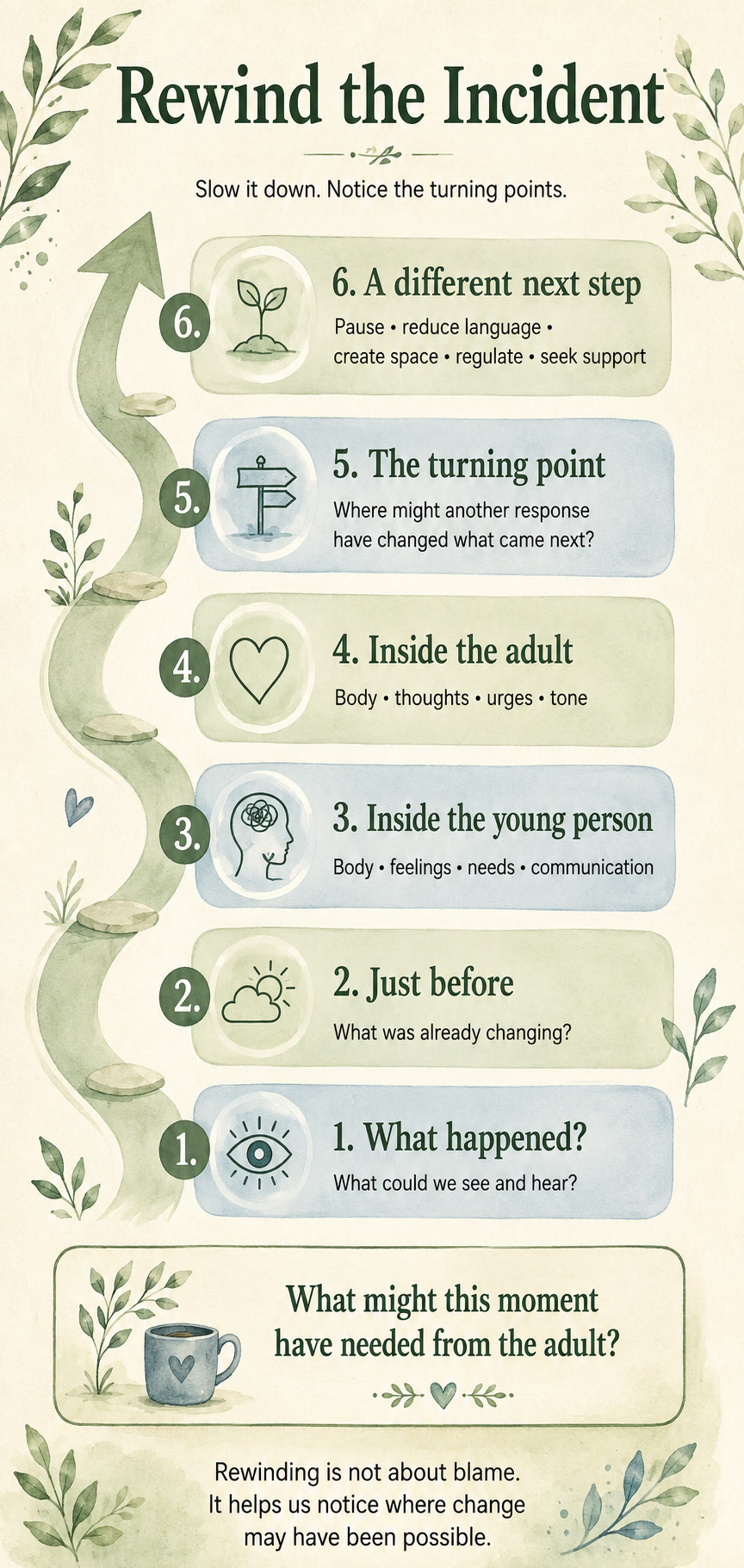
Move through the incident slowly. Look for what happens between the visible moments.
123
Video 1 · Meet Maya and Steve
Pause for group discussionWhat might this situation need from the adult?
Video 2 · Repair becomes pursuit
Pause for group discussionHold the turning points in mind before continuing.
Video 3 · A PACE-informed approach
“Accountability does not require emotional withdrawal.”
“Connection does not remove accountability.”
Slow it down. Notice the turning points and where another response might have changed what came next.
06 · Hold the relationship
After the incident
Repair can hold safety, impact and relationship together. It does not ask anyone to pretend that harm did not happen.
01
Accountability
What needs to be understood, owned or put right?
02
Natural outcomes
What follows meaningfully from what happened, without adding shame?
03
Relational authority
How can the adult stay clear, steady and connected?
Low-pressure openings
Repair can begin quietly
Tap a phrase to hold it in mind. The words matter, but tone, timing and felt safety matter too.
07 · Notice what stays with you
Leaving today
There is no need to leave with every answer. Notice what has shifted, what you want to practise and what needs more thought.
✓
Anonymous group reflection
Ready to share what you want to share?
You can submit whatever you have chosen to answer. Your name, email and device details are not collected. Please avoid including names or details that could identify a young person, colleague or yourself.
Not submitted yet
Next week
PACE in real-life practice
We will return to today’s questions and explore how playfulness, acceptance, curiosity and empathy can support everyday moments, boundaries, uncertainty and repair.
Thank you for bringing your experience, questions and uncertainty into the room.